
This is just a draft. It has probably lots of errors. Do not use.
Direkt Demokraterna (DD) is a Swedish non-affiliated neutral political party, based on the principles of Direct Democracy.
DD proposes that there exists a democratic deficit in today’s society. It cites the falling membership and engement levels in established parties while at the same time an increase in discussing political issues particularly from the younger demographic bands. DD are also aware that more and more decisions have devolved to the EU and lobbying within that forum has gained considerable influence.
The Direct Democrats’ (DD) core idea is that it referenda can be executed securely through the Internet on political issues, in a way that directly engages the electorate on issues that affect them, through a DD representative in the Parliament, or other local body (i.e. municipality). In this way the electorate is able to vote and influence their DD representative directly on current issues. In addition to voting directly on issues, everyone should also have the opportunity use the DD representative to present policy proposal ideas that DD members can develop into motions.
History

The Direktdemokraterna (”Direct Democrats”) party was approved by the Swedish Election Authority April 4, 2014. This new party was a merger of three Direct Democracy parties; Demoex, Aktiv Demokrati, och Äkta Demokrati. DD’s short term goal was to introduce the idea of a direct digital democracy (DDD) in Sweden by running for election in 2014.
In the Swedish election 2014, 0,89% of the voting electorate choose to register a protest vote to demonstrate their dissatisfaction with the choice of candidates or refusal of the current political system. 14.19% did not bother to vote at all. 4.09% voted, but for one of the SEA registered parties that did not pass the highly criticized 4% electoral threshold, effectively resulting in as not having voted at all.
Direct democracy application
Direktdemokraterna is developing an iOS application with the aim of delivering Direct Democracy through the use of blockchain technology. It is planned to be released ahead of the Swedish 2018 September election, for use should a Direktdemokraterna representative be elected to the Swedish Parliament.
Challenges
Election threshold
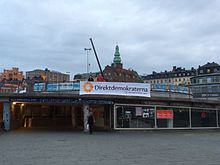 Due to the arbitrary 4% barrier (electoral threshold) to enter parlament, new parties face an enormous credibility problem as the electorate do not want to waste their vote on a party with no power in parliament.
Reaching the 250,000 (4%) threshold is the key barrier to ensuring the success of DD. To enable tracking of the commitment of the electorate to breach the 4% threshold, DD will request registration for DD use, effectively a small membership fee.
Marketing costs
The state (taxpayer) pays the ruling parties 466,000,000 SEK and is the reason the ruling parties can afford to carpet bomb Sweden with their political posters ahead of election. New parties have to pay for marketing out of their on pockets.
For ease, the membership fee can be taken as a in-app subscription purchase as a token of commitment for voting unlocking some features. Any money generated will be primarily used for marketing purposes, the generating more members in a typical crowdfunding model. The membership numbers will be transparent through the app, and DD website with the goal to pass the barrier, reaching approx. 250,000 members before the next election in September 2018.
Cost of ballot papers

In Sweden, the state (taxpayer) pays the cost of printing and the distribution of ballot papers for parties that received at least 1% votes in the previous election. The cost for the Election Authority for the printing, distribution, and training of personel is approx. 250,000,000 SEK. Since Sweden uses individual ballots for each party and type (i.e. parlament or municipality), new parties such as DD, therefor have to pay for printing and distribution themselves. This system is highly criticized due to it’s unjust set-up and private suggestions from within the Election Authority itself is to use the Finish model where each candidate is assigned a 3-digit number.